Reviews
Rose’s work has received praise from a variety of sources.
First Symphony.
Jeremy Hulin, music professor at the Maastricht Conservatorium and, from 1993 to 2005, first conductor at the Aachen Opera Theatre: “Everything seems to grow organically from the beginning with a lot of variety in it and a lot of open-air atmosphere – quite an achievement.”
Cello Sonata.
The Art Music Lounge said that it is: “full of dissonance from the very first note and plays on dissonance throughout. This is not to say that the music is vapid or uninteresting; on the contrary, it is full of interesting ideas. I particularly liked the second movement with its insistent march rhythm, allied to rising and falling chromatic passages. All in all it’s a very clever piece.”
Ken Meltzer for Fanfare: “In his liner notes on the works, (sonatas by Rose and Shostakovich) Rose mentions Shostakovich’s acknowledgement of the influence of Stravinsky in his Cello Sonata. Rose, too embraces that influence in his sonata, particularly in the second movement scherzo, with its striking echoes of L’histoire du soldat. Rose and Shostakovich both explore the cello’s expressive potential, particularly in its middle and lower registers. I don’t want to give the impression that the Rose Cello Sonata is in any way an imitation of the Shostakovich. Each composer speaks in his own individual voice. And it’s no small compliment, I think, to say that in this recording, the Rose Cello Sonata justifies its place alongside the Shostakovich.
The artist bios and Rose’s excellent program notes all enhance this first-rate production. A worthy project and one, I think, that merits your attention; recommended.”
Piano Fantasia.
Robert Matthew-Walker for Musical Opinion Quarterly: “it lies in no way outside of the broad spectrum of acceptance and genuine musical interest of the other three works here. This disc is thoroughly recommended.” (Leighton, Rachmaninov and de Falla.) Dominic Hartley for Fanfare: “the feeling of listening to the whole is one of incremental but satisfying progression, a large picture slowly coming into focus – an attractive and original contribution to the fantasia genre.”
Huntley Dent for Fanfare: “In toto Rose has attempted to create an imaginative arc held together by continuous organic development, something that is hard to achieve in an abstract idiom without melodic momentum. The cohesion is relatively easy to follow by ear; Rose leaves identifiable signposts along the way.”
Martin Cousin, pianist: “form and craft are in abundance but creativity and imagination are the two most important elements………his own individual voice always shines through with total commitment.”
Piano Trio.
BBC Music: “A master of unconventional form taking only the broadest of cues from the seven-movement continuity of Beethoven’s Op. 131 String Quartet, Rose sacrificed composing for the law but has since made up for lost time. Like most composers when they took up the piano trio form he has much to lament, in this case USA shootings and war crimes in Syria which lie behind the cumulative elegy of the final movement. Despite that, and constant reference to a Passacaglia theme, the essence is mercurial, sometimes even playful, and the light which shines through allows the work to end in peace. It’s certainly a richly wrought and fascinating addition to the piano trio repertoire.”
Gramophone: “The work is cast in seven movements, with anticipatory or recollective links drawing these into a cohesive yet intentionally non-seamless whole. Most impressive are the second-movement passacaglia with its combative dialogue for strings and piano, then the final Largo, whose elegiac intensity pointedly underlines those mass shootings and war crimes such as provided the creative spur.”
Huntley Dent for Fanfare: “[it] is a remarkable and almost seamless transition between the Romantic idioms of Smetana and Rachmaninoff. There’s a good deal of scrupulous craftsmanship at work employing traditional forms like the fugue and passacaglia, circular returns to previous material, solos for each instrument, and a general sense of close joinery.
“Form has little to do with emotion, and where Rose succeeds best is in his ability to connect emotionally with the listener. His themes display a gift for melody, and he makes dramatic use of instrumental color. The result is unexpectedly successful—unexpected because one feels that this must be a Russian work, so closely aligned with Shostakovich in dramatic variety and Rachmaninoff for passionate elegy that the connection seems undeniable. The work is a triumph of traditionalism without a trace of tiredness or routine. Rose’s Piano Trio deserves wide recognition. Warmly recommended.”
Planetary Conjunctions.
John Gerson, concertmaster of The Symphony of Oak Park and River Forest: “I find it to be a fantastic work. Each movement has a special character” but “it also tells a longer story. The string and brass writing are especially lovely and there are also some great moments in the percussion.”
“Jeux, Danses et Fetes.”
The Kodaly String Duo of Vienna: “the musical effects and the rhythmic combinations surely will capture the audience’s attention and they will enjoy every second of this composition.”
Danses pour Quatour and String Quartet number four.
Huntley Dent for Fanfare said of Danses pour Quatuor, “it has a live, fresh quality that holds your attention whether a particular passage is tonal or spiced with dissonance. If more widely heard, it has the potential for enthusiastic audience response” and
“In string quartet number four his thematic material is warm and often heartfelt. Whether he uses melody or quasi-melody, the lyrical intent is unmissable. Rose has a gift for development/transformation without losing the thread. I can offer the warmest recommendation.”
John Turner, the world-renowned recorderist: “Beautifully wrought and memorable music. Congratulations!”
Gramophone: "Both compositions show a keen understanding of writing for strings and the sense of community and dialogue so essential in the best quartet-writing." Of the Danses: "The design succeeds in all essentials undemonstratively attaining a high level of achievement." Of the fourth quartet: "a subtle, nuanced work of absolute music (whose) five movements, including a hefty finale, need and repay repeated listening. Excellent performances and superb sound set the seal on a quietly revelatory release."
Ken Meltzer for Fanfare said of Danses pour Quatour, “the writing is colorful and transparent throughout. His gift for beguiling melody is a decided asset. All of the dances are highly satisfying. The charming, seductive Tango could hold its own as a delightful encore” and
of String Quartet number four “both the foundational material and its instrumental settings abound with elegance. The positive attributes of Danses pour Quatuor join forces with inventive thematic development.”
Keith Fisher for Fanfare: “The quartet writing here is very assured. The Danses pour Quatuor are a contemporary take on the Baroque suite. The opening Rigaudon, albeit in A-B-A form, is unusual. At the outset the scoring reminded me texturally of Stravinsky’s writing for string quartet, but that similarity soon dissipated, never to return. What we get instead are a series of witty pastiches of these disparate dance forms. The variation formatting in the “quasi ciaccona”- influenced sarabande is skillfully handled, and the Latin and jazz elements of the fourth and fifth movements creatively perpetuate the droll humor on display throughout the suite.
“The fourth string quartet is unmoored from Baroque or dance-form influences and represents a kind of melodically enhanced homage to the Bartókian string quartet model. Developmental procedures are fused with the English pastoral tradition. But whether the inspiration is gamboling or endless melody, this music never wears out its welcome. Everything receives highly accomplished and sympathetic performances from the Tippett Quartet. Highly recommended.”
Henry Fogel for Fanfare: “This disc is my first encounter with Rose’s music, but it will not be the last.
“Few composers could legitimately cite models as disparate as Elgar, Shostakovich, Bartók, and Stravinsky, but there are elements of all of them in Rose’s style. What strikes me is his own strong, personal voice, though, and a melodic gift. Rose clearly wants to connect with the audience rather than expect the audience to come to him.
“Danses pour Quatuor is charming, inventive, witty, and beautiful.
“Rose describes the very recent Fourth String Quartet from 2024 as ‘absolute music, the essence of which is organic growth through development or transformation.’ He points out the quartet’s overall arch-like shape, which was influenced by Bartók. The idiom is more austere and dramatic than in the Danses, but Rose’s gift for melody is apparent throughout. It is strong enough to sustain interest for the entire 37-minute length.
“The first movement demonstrates the composer’s skill in balancing elements of tension and release. It is followed without pause by an Allegretto that recalls a slow waltz but which varies the rhythms to keep you on your toes. This flows directly into the third movement, an Adagio, which strikes me as the emotional core of the piece. It begins with touching lyricism, and slowly Rose increases the intensity until reaching a dissonant climax (a similar shape to Barber’s Adagio for Strings). The fourth movement is a brief, delicate scherzo-like Allegro, and the quartet ends with the longest movement, a 10-minute fugue that is alternately dramatic and calm.
“Here, adding the deeply committed and communicative performances by the Tippet Quartet along with the well-balanced recorded sound, you have a disc that I can recommend with enthusiasm.”
Colin Clarke for Fanfare: “The Danses has no Overture; instead, a ‘Rigaudon,’ a form especially popular with Rameau. There are some folkish tinges to the writing; a central section is in slower tempo, with a really quite slinky and seductive melody. The Tippett Quartet’s performance is exemplary; the players capture the melancholy of the ‘Sarabanda (quasi ciaccona)’ well, too. The third movement is a ‘Walzer.’ I do like the way Rose overlaps and segments material at the movement’s close: it feels quite Bartókian. We move closer to our own times, then, with a ‘Tango (quasi habanera)’, like the second movement a clever combination or juxtaposition of two forms. It is a lot of fun, and the members of the Tippett Quartet certainly seem to enjoy themselves, accents characterfully thrust at the listener. On, then, to a ‘Blue Foxtrot’, which is very cleverly, neatly composed, including a set of seven ‘variants’ (including an imitation of the banjo by the violins). The final ‘Invention’ refers to ‘an original product of the imagination implying no particular musical characteristics.’ It is the spirit of dance that is celebrated; and the Tippett Quartet delivers a notably light-of-foot account. Fragments of previous dances are incorporated into Rose’s fabric. It is all very clever, and Rose could not ask for a better performance.
“The Fourth Quartet is absolute music and in its five-movement arch form again references Bartók. The pacing of [the opening] Andante in this recording is perfect and the Tippett Quartet realizes Rose’s idea of the second subject group occupying a different ‘plane,’ a higher register, superbly. This is music that rewards close attention, sometimes veering into a sort of tenderly haunting space. A tripartite scherzo follows, an Allegretto with waltz-like tendencies, suavely delivered here. At the heart of the piece, though, is the Adagio. The movement owes much to late Beethoven in its fragile, slow unfolding (all credit to the Tippett Quartet for sustaining this). This is fine music indeed, unhurried, even transcendent at times. The fourth movement, an Allegro, is a scherzo, but a lighter one than the first. Staccato is beautifully done here by the upper instruments, while Rose’s melodic invention, whether in the mercurial upper or the slower-moving lower voices, seems at its height. A Moderato finale might in itself imply Shostakovich. Intended as a ‘counterbalance’ to the preceding four movements, it is more like a skeleton of a fugue, and very effective for it. Each section is heard in a different key area and is demarcated via its characteristics, bringing in a touch of variation form to the mix. It does work well; the effect here is of a satisfyingly demanding work that holds much coherence.”
The Tippett Quartet: “We have just finished recording a selection of works by Lawrence Rose which has been a really interesting discovery. His influences of late Beethoven are clear and his ability to write in many styles very impressive and enjoyable.”
Some general comments.
Gerald Elias, former member of the Boston Symphony Orchestra then, Associate Concertmaster of the Utah Symphony Orchestra, Abramyan String Quartet founder and first violin, and now an acclaimed writer and crime fiction novelist said of Rose’s string quartet, Danses pour Quatuor: “I enjoyed listening to the Danses which I found clever and engaging”; of the first violin concerto: “could be a strong addition to any programme”; of the piano quartet (“for DSCH”): “You compose with an impressively confident and clear voice. I can express nothing but admiration for your continued achievement.”; of the third symphony: “Terrific” and of the slow movement of the cello sonata: “sublime.”
Katherine Jenkinson, cellist, said of Rose’s music generally: he “is able to write beautiful long lyrical lines and takes advantage of the entire range of the instrument he’s writing for”; of Danses pour Quatuor: “I was immediately struck by how well Rose writes for string players” and of the piano trio: “this is well considered and lies beautifully for the instruments. Rose is certainly a composer to look out for, gaining reputation with every composition. It has been a joy working alongside him.”
Ruth Rogers, the leader of the London Mozart Players and guest leader of many other orchestras as well as founding member of the Aquinas Piano Trio, said: “I have recorded and performed Rose’s string quartet and piano trio. He is a thoughtful composer who takes great care of the details and I have enjoyed playing his colourful, imaginative and original pieces. His music is fresh and always interesting and he understands how to get the best out of instruments in terms of texture and colour.”
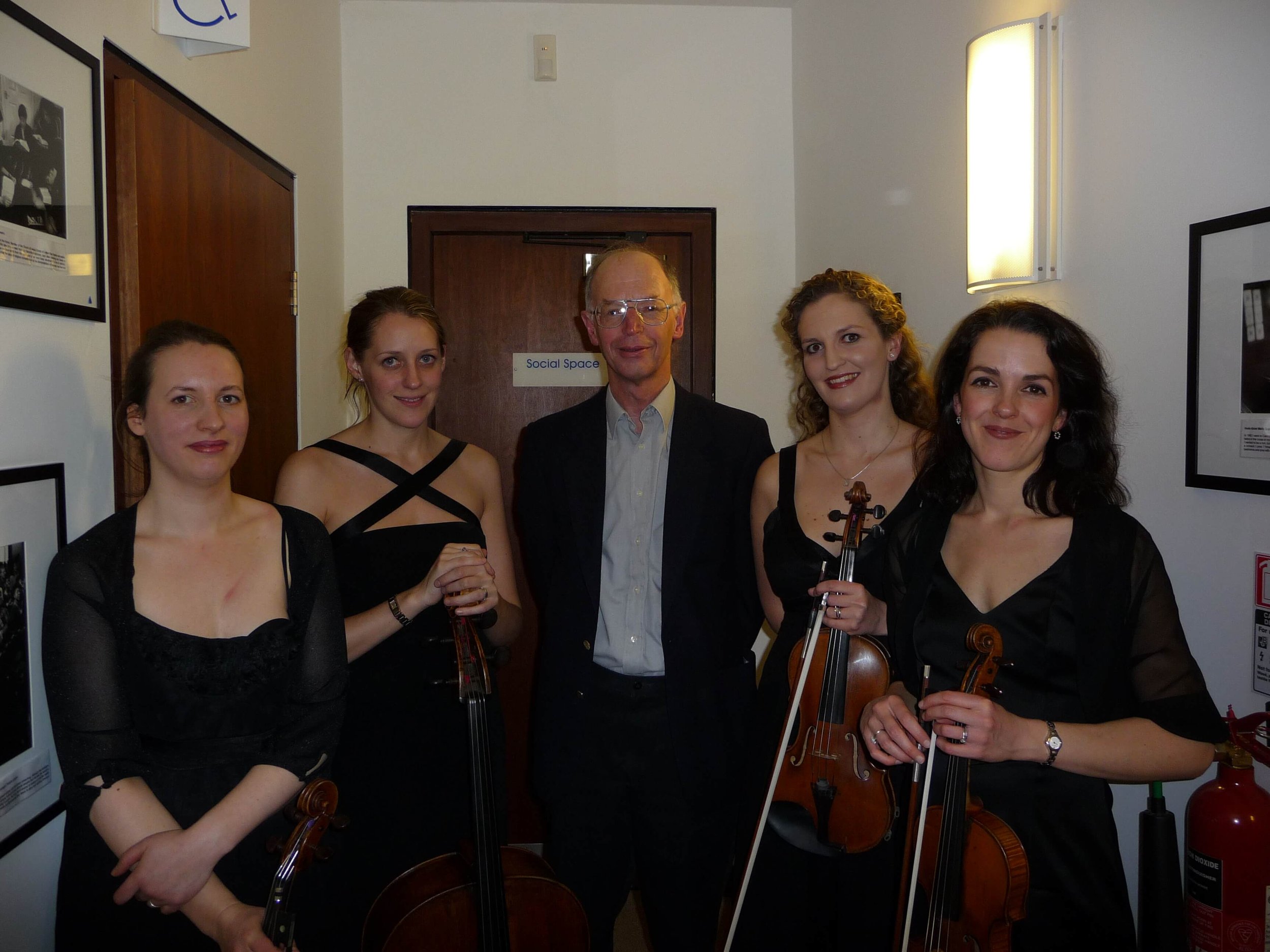
The Composer with the Iuventus String Quartet (Ruth Rogers, Elizabeth Willams, Rose Redgrave and Katherine Jenkinson)